JWST Data in the Exoplanet Archive
Mission Overview

NASA's James Webb Space Telescope (JWST) launched on December 25, 2021 aboard an Ariane 5 rocket from Europe's Spaceport near Kourou, French Guiana. The space telescope offers unprecedented photometric precision, extreme thermal stability, and broad infrared coverage (0.6 to ~28 microns) across its primary science instruments. Operating in a low-background deep-space (Earth-Sun L2) orbit, JWST primarily characterizes exoplanets using precision transmission, eclipse, and phase-curve spectroscopy, as well as direct imaging.
The NASA Exoplanet Archive supports JWST-enabled research by providing data and services listed on this page.
JWST Data in the Exoplanet Archive
NASA Exoplanet Archive Atmospheric Observation List (NExoList)
The NExoList service records all archived and planned JWST atmospheric programs for transit, eclipse, and phase curve observations. The information is sourced from the Transiting Exoplanets List of Space Telescope Spectroscopy (TRExoLiSTS), originally described by Nikolov, Kovacs, and Martlin (2022, Res. Notes AAS, 6, 272). NExoList content includes observation status and observation dates and is updated weekly to reflect the current status of JWST programs.
- Access the NExoList web interface at: https://exoplanetarchive.ipac.caltech.edu/cgi-bin/observations/nph-firefly?data
- Learn more about the NExoList service in the User Guide: https://exoplanetarchive.ipac.caltech.edu/cgi-bin/observations/nph-firefly?
- Retrieve all NExoList data in IPAC Table format with the following TAP query: https://exoplanetarchive.ipac.caltech.edu/TAP/sync?query=select+*+from+nexolist&format=ipac
System and Spectral Data
| Data Type | Description |
|---|---|
| View All JWST Spectra | This link displays all JWST exoplanet spectra in the Atmospheric Spectroscopy table. |
| View All Transmission Spectra | This link displays all JWST transmission spectra in the Atmospheric Spectroscopy table. |
| View All Eclipse Spectra | This link displays all JWST eclipse spectra in the Atmospheric Spectroscopy table. |
| View All Direct Imaging Spectra | This link displays all JWST direct imaging spectra in the Atmospheric Spectroscopy table. |
| View All Confirmed Planets Discovered by JWST | This link displays all confirmed planets discovered by JWST in the Planetary Systems Composite Data table. |
More JWST Science Resources
The archive has also integrated the following features into its services to support JWST-related research and observational planning:
| Feature | Description |
|---|---|
| Planet Emission Spectroscopy Metric (ESM) & Transmission Spectroscopy Metric (TSM) | The archive provides ESM and TSM calculations based on Kempton et al. (2018) in the Planetary Systems Composite Data table. More information about the calculations are described in How the Archive Calculates Values in the Planetary Systems Composite Parameters Table. |
| More Calculated Values | Planetary parameters for planet insolation (pl_insol) and planet equilibrium temperature (Teq, or pl_eqt) are provided as calculated values in the Planetary Systems Composite Data table when all required values for the calculation are present, and when published values are otherwise not available. The reference will display Calculated Value instead of the paper that reported it—the same practice the archive follows for calculated radius values. |
| NExoList Counts | The Planetary Systems Composite Data table has columns that indicate the number of eclipse, transmission, and direct imaging spectra currently in NExoList. The parameters are described on the PS tables column definitions page. |
| Spectroscopy Counts | The Planetary Systems Composite Data table has columns that indicate the number of eclipse, transmission, and direct imaging spectra from all facilities (including JWST) that are currently in the Atmospheric Spectroscopy table. The parameters are described in the PS Tables Column Definitions. |
| JWST Atmosphere Observation List Plot | This pre-generated atmosphere observation scatter plot shows all confirmed planets in mass-orbital period space using data from the Planetary Systems Composite Data table. |
| System Overview Page Integration | Clicking on a planet name in NExoList displays the System Overview page. Also, the NExoList: JWST link on System Overview pages goes to a filtered version of NExoList for the planet flagged with the  icon. icon. 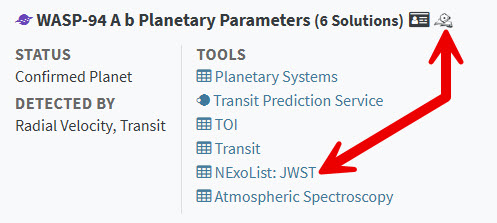 |
Request for Acknowledgement
To cite the NASA Exoplanet Archive in your research, please use the standard text listed at the top of the Acknowledgments page. The digital object identifier (DOI) assigned to the NExoList service is 10.26133/NEA46.
Last updated: 1 October 2026