2026 Exoplanet Archive News
Sign up for Exoplanet Archive email updates
This page contains a summary of the current calendar year's Exoplanet Archive news. For other news archives by year, see the 2025, 2024, 2023, 2022, 2021, 2020, 2019, 2018, 2017, 2016, 2015, 2014, 2013, and 2011-12 archives.
To view only the most recently added planets and updated parameters (default and non-default), see this pre-filtered and pre-sorted interactive table.
September 3, 2026
Eight New Planets
This week, the archive welcomes eight new planets: CD-35 2722 B b, HD 50554 c & d, KMT-2025-BLG-0975L b, KMT-2025-BLG-1160L b, TOI-3053 b, TOI-3278 b, and TOI-4409 b.
We also bid adieu to WASP-126 c, which is now listed as a False Positive Planet based on a published refutation. Its data remain on the WASP-126 System Overview page and have been removed from the Planetary Systems tables.
There are also new parameters for 19 planets: DMPP-7 b, HAT-P-18 b, HD 114082 b, Kepler-82 b, c, & f, Kepler-419 b & c, Kepler-725 b & c, KOI-142 b & c, KOI-872 b & c (a.k.a. Kepler-46 b & c), KOI-884 d & e, TOI-1173 b, and WASP-107 b & c.
Click on a planet name to go directly to its System Overview page, or browse the Planetary Systems and Planetary Systems Composite Data tables.
News panel image credit: NASA/Carter Roberts
August 27, 2026
We Made AstroFetch Happen!
We're excited to announce that AstroFetch, an AI-powered assistant that answers natural-language questions about exoplanets using archive data, is now in open beta.
The service has been integrated into the Exoplanet Archive's Explore the Archive search interface on the home page. A free AstroFetch account is required to view results; sign up at astrofetch.ipac.caltech.edu. Note that account approval may take up to three business days.
To use the service:
- Click the Query AstroFetch AI tab.
- Enter a question in the text field, such as "Compare the radii of confirmed exoplanets discovered by the transit method vs radial velocity" or "Plot a histogram of stellar effective temperatures for systems with multiple confirmed planets, with a log y-axis."
Note: AstroFetch is optimized for natural-language queries. For radius and single-object searches based on object names or coordinates, please continue using the Search Inventory tab.

- Click Query AI to view your results in a new browser tab within the AstroFetch interface.
The service is in open beta, which means we want to hear what you think! Please check the AstroFetch Frequently Asked Questions and send your feedback and suggestions to astrofetch-help(at)ipac.caltech.edu.
August 20, 2026
What's New (and Old): 18 Planets, Including a TESS Discovery Around an Ancient Star
This week's planetary haul includes Gl 725 B c (a.k.a. GJ 725 B c), a habitable-zone exoplanet just 11.4 light-years from Earth, and TOI-7169 b, a planet orbiting a star that has one of the highest measured ages in the archive.
The Gl 725 B system includes planet candidate Gl 725 B b, which we have also added to enable follow-up study. Learn more about this interesting system in the IRAP media release and discovery paper.
The other 16 new planets added this week are HD 202206 b, HIP 81991 b, KOI-319 b & c, KOI-884 e, MOA-2020-BLG-108L b, TOI-603 b, TOI-2114 b, TOI-4492 b, TOI-5806 b, TOI-5811 B b, TOI-6158 b, TOI-7189 b, TOI-7265 B b, TOI-7393 b, and TOI-7394 B b.
There are also new data for HD 202206 c, KOI-884 d, NGTS-10 A b, OGLE-2014-BLG-0676L b, and TOI-5916 b.
Click on a planet name to go directly to its System Overview page, or browse the Planetary Systems and Planetary Systems Composite Data tables.
News panel image credit: IRAP/Aurore Bouchet
August 6, 2026
Three's Company
This week's new planets include TOI-5628 A b, a rare giant planet orbiting an M dwarf with an associated white dwarf companion, and HD 60779 b & c, a pair of planets orbiting a bright, Sun-like star.
New data have also been added for CoRoT-1 b, HAT-P-18 b, K2-24 b & c, K2-312 b & c (a.k.a. HD 80653 b & c), TOI-442 b (a.k.a. LP 714-47 b), TOI-4438 b, TOI-4504 b, c, & d, and Qatar-4 b.
Click on a planet name to go directly to its System Overview page, or browse the Planetary Systems and Planetary Systems Composite Data tables.
News panel image credit: University of Warwick/Mark Garlick
July 30, 2026
Nine New Planets, Including TESS's First Microlensing Planet
This week's new planets feature Gaia23braL b, the first microlensing planet confirmed by NASA's TESS. Its discovery in TESS data was made possible after ESA’s Gaia telescope flagged the initial microlensing event. Learn more in the NASA media release and the discovery paper.
The other new planets are Gliese 48 b, HAT-P-47 b. NGTS-39 b, TOI-2040 b, TOI-2049 b, TOI-2578 b, TOI-4427 b, and TOI-4458 b. There are also new data for HD 3167 b, c, d, & e, TOI-260, TOI-1710 A b, TOI-2134 b & c, WASP-156 b, and YSES-1 b.
Click on a planet name to go directly to its System Overview page, or browse the Planetary Systems and Planetary Systems Composite Data tables.
We've also added 55 new atmospheric spectra for 34 planets to the Atmospheric Spectroscopy Table.
News panel image credit: NASA’s Goddard Space Flight Center
July 16, 2026
Five New Planets, Including Two of the Least-Dense Planets Ever Found
This week's new planets include TOI-791 b & c, two Jupiter-sized planets with densities so light they're compared to cotton candy. They're also considered to be among the puffiest worlds found to date! Learn more about these rare discoveries in the NASA media release and the discovery paper.
The other new planets are TOI-1533 b & c and TOI-6884 b. There are also new data for HD 15337 c, HIP 41378 b, c, d, e, f, & g, K2-93 b, c, d, e, f, & g, KELT-9 b, LHS 3844 b, WASP-43 b, WASP-100 b, and WASP-121 b.
Click on a planet name to go directly to its System Overview page, or browse the Planetary Systems and Planetary Systems Composite Data tables.
A new Hubble transmission spectrum captures AU Mic b’s atmosphere escaping in sudden, intermittent bursts due to its terrifying host star. These wild system dynamics were previously immortalized in NASA’s spooky "Flares of Fury" poster and video. The other planets with new spectra in the Atmospheric Spectroscopy Table are HAT-P-30 b, HD 15337 c, LHS 3844 b, WASP-43 b, WASP-100 b, and WASP-121 b.
News panel image credit: NASA/Daniel Rutter
July 9, 2026
Four Planets Added, Including a Third Discovery in the Beta Pictoris System
This week's update delivers data for 18 planets, highlighted by four new discoveries—including a third planet in the Beta Pictoris system. Simultaneously announced by Suttlief et al. (2026) and Gibbs et al. (2026), the discovery of bet Pic d makes Beta Pictoris only the second directly imaged system known to host more than two confirmed planets.
The other new planets are NGTS-38 b, TOI-2147 b, and TOI-6019 b. The planets with new parameters are eps Ind A b, GJ 367 b, HAT-P-5 b, HAT-P-32 A b, HAT-P-38 b, K2-25 b, Kepler-79 d, LHS 1140 b, TOI-1272 b, TOI-1694 b & c, WASP-7 b, WASP-72 b, and WASP-127 b.
Click on a planet name to go directly to its System Overview page, or browse the Planetary Systems and Planetary Systems Composite Data tables.
We've also updated the status of TOI-1272 c to False Positive Planet (FPP) based on a published refutation. The object's data have been removed from the Planetary Systems tables, but remain on the TOI-1272 System Overview page.
There are also new spectra for 21 planets added to the Atmospheric Spectroscopy Table: HAT-P-5 b, HAT-P-6 b, HAT-P-32 A b, HAT-P-38 b, HD 189733 b, HD 209458 b, K2-25 b, Kepler-79 d, KELT-1 b, KELT-3 b, KELT-9 b, eps Ind A b, LHS 1140 b, WASP-3 b, WASP-7 b, WASP-19 b, WASP-62 b, WASP-72 b, WASP-121 b, WASP-127 b, and XO-3 b.
News panel image credit: GRAVITY Collaboration/A.M. Quetz/MPIA Graphics Department
July 2, 2026
A Plethora of Planet Data and Spectra
This week's update features 19 new planets, 48 new spectra (including seven of the TRAPPIST-1 planets!), and new data for 11 planets. One planet has also been demoted as a false positive.
New Planets and Data
This week's new planets are HD 125136 b, HD 126105 b, HD 127195 b & c, HD 190360 d, HIP 8923 b, HIP 10090 b & c, HIP 39330 b, HIP 98599 b, KMT-2023-BLG-0332L b, KMT-2023-BLG-1592L b, OGLE-2023-BLG-0766L b, TOI-3664 b, TOI-4034 b, TOI-6564 b, TIC 150070085 b, TIC 52059926 b, and TIC 9344899 b.
New data have also been added for 51 Peg b, eps Eri b, HAT-P-11 b, HD 190360 b & c, HIP 21850 b & c, TOI-199 b, TOI-1710 b, TOI-1883 b, TOI-4602.01, WASP-18 b, and WD 0806-661 b.
Click on a planet name to go directly to its System Overview page, or browse the Planetary Systems and Planetary Systems Composite Data tables.
We have also updated the status of WASP-18 c to False Positive Planet (FPP) based on a published refutation. The object's data have been removed from the Planetary Systems tables, but remain on the WASP-18 System Overview page.
New Transmission and Eclipse Spectra
Seven of this week's 48 new spectra are of six planets in the TRAPPIST-1 system, all taken by NASA's Hubble Space Telescope. The planets with new spectra are: HAT-P-11 b, HD 149026 b, HD 189733 b, HD 209458 b, HD 80606 b, KELT-16 b, MASCARA-1 b, Qatar-1 b, TOI-199 b, TRAPPIST-1 b, c, d, e, f, & g, WASP-12 b, WASP-33 b, WASP-43 b, WASP-52 b, WASP-94 A b, and WASP-121 b.
You can find the new spectra by browsing the Atmospheric Spectroscopy Table, or get a pre-filtered table for a specific target by going to its System Overview page, clicking on the planet's Planetary Parameters section, and then clicking the Atmospheric Spectroscopy link under Tools.)
But Wait, There's More!
We've also added another archive video tutorial that walks you through the new Published Data Upload service. Check it out on our YouTube channel—as well as the other videos in the playlist—and let us know what you think! We'd also love to hear your ideas for other instructional videos about the archive.
News panel image credit: NASA, ESA, and G. Bacon (STScI)
June 18, 2026
Start Planet-ing Your JWST Observations with NExoList
We're excited to announce NExoList: the NASA Exoplanet Archive Atmospheric Observation List, a new service created to make JWST proposal planning easier and more streamlined.
NExoList is designed to help users with their proposal planning for NASA's James Webb Space Telescope (JWST) by providing a fully integrated workflow to find the best JWST targets for their science questions—as well as targets that have already been observed. The table is particularly useful for researchers who are new to JWST and learning which of the telescope's instruments, modes, and subarrays are appropriate for their use cases.
The service contains all archived and planned JWST atmospheric programs for transit, eclipse, and phase curve observations from NIRSpec, NIRISS, NIRCam and MIRI, with plans to integrate more observatories. The information is sourced from the Transiting Exoplanets List of Space Telescope Spectroscopy (TRExoLiSTS), originally described by Nikolov, Kovacs, & Martlin (2022, Res. Notes AAS, 6, 272). NExoList content includes observation status and observation dates and is updated weekly to reflect the current status of JWST programs.
The Exoplanet Archive has enhanced its tools and data to support NExoList-related workflows and easier exploration of the data, including:
- ESM and TSM Columns: The Planetary Systems Composite Parameters (PSCompPars) table now includes columns for Transmission Spectroscopy Metric (TSM) and Emission Spectroscopy Metric (ESM), with calculations based on Kempton et al. (2018). More information about the calculations are provided in How the Archive Calculates Values in the Planetary Systems Composite Parameters Table.
- New Calculated Values: Planetary parameters for planet insolation (
pl_insol) and planet equilibrium temperature (Teq, orpl_eqt) are now provided as calculated values in the PSCompPars table when all required values for the calculation are present, and when published values are otherwise not available. The reference will display Calculated Value instead of the paper that reported it—the same practice the archive follows for calculated radius values. Refer to How the Archive Calculates Values in the Planetary Systems Composite Parameters Table for details. - Check the Spectra: New columns in the PSCompPars table indicate the number of eclipse, transmission, and direct imaging spectra currently in the Atmospheric Spectroscopy Table for a given planet, as well as the total number of JWST transit, eclipse, and phase curve observations from NExoList for the planet.
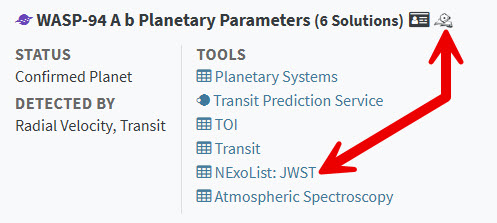
- System Overview Page Integration: The new NExoList: JWST link on System Overview pages goes to a filtered version of the table for the planet flagged with the
 icon.
icon.
- JWST Atmosphere Observation List: This new pre-generated atmosphere observation scatter plot shows all confirmed planets in mass–orbital period space using composite parameters from the PSCompPars table. Gray markers indicate planets without JWST spectra; planets with JWST spectra (currently not including JWST directly imaged planets) are marked with a symbol and color based on the observation method (or combination of methods) used to observe the planets.

Learn more about NExoList and how to use it by clicking on the User Guide tab within the service. Then, after you've had a chance to try out the service, let us know what you think!
June 4, 2026
New Feature: Transit Service API
Our popular Transit and Ephemeris Service has a new feature to optimize your observation planning: an application programming interface (API) that supports automated and direct retrieval (e.g., within your Python environment) of transit prediction results in a machine-readable format.
More about this new feature:
- Supports synchronous and asynchronous modes.
- Supports queries for single targets as well as pre-defined datasets (e.g., all confirmed RV planets, all confirmed KOIs, all TESS Objects of Interest) hosted by the Exoplanet Archive.
- Supports file uploads of custom target lists in .txt, .csv, and .tsv file formats.
- Accepts the same query parameters as the web version of the service.
Check out the Transit API documentation, which includes ready-to-use examples, try it out, and let us know what you think!
Seven New Planets and 11 Spectra
This week's seven new planets feature GJ 3378 b, a super-Earth around a nearby M dwarf in its host star’s conservative habitable zone. We've also reinstated four previously demoted or excluded objects based on new data published in Piccinini et al. (2026). The four planets now have Confirmed status in the archive, and are also flagged as Controversial due to ongoing discussions about these planets in the literature. The reinstated planets are noted in the following list with an asterisk (*).
Planets added this week: GJ 3378 b, HD 5388 b*, HD 6718 b*, HD 16760 b*, HD 148427 b*, TOI-707 b, & TOI-3457 b. There are also new parameters for 11 planets: GJ 463 b, HD 141937 b, HD 222237 b, HD 96127 b, HIP 65891 b, K2-33 b, K2-106 b, pi Men b, TOI-1259 A b, TOI-1728 b, & TOI-4507 b.
Click on a planet name to go directly to its System Overview page, or browse the Planetary Systems and Planetary Systems Composite Data tables.
The planets with 11 new spectra in the Atmospheric Spectroscopy Table are GJ 436 b, HAT-P-12 b, HAT-P-32 b, K2-33 b, WASP-19 b, & WASP-43 b.
May 21, 2026
New Atmospheric Spectra for a sub-Neptune Companion to a Hot Jupiter
This week's 21 new spectra include four of TOI-1130 b, a sub-Neptune found inside the orbit of hot Jupiter TOI-1130 c. The new JWST transmission spectra support a theory that both planets formed and built up their atmospheres beyond the frost line before migrating in. Learn more about this planetary odd couple in the MIT media release and discovery paper, then check the Atmospheric Spectroscopy Table for the data.
There are also new spectra for COCONUTS-2 b, KELT-20 b, LTT 9779 b, NGTS-2 b, WASP-18 b. WASP-96 b, and WASP-127 b.
The new planets are TOI-237 c, TOI-4311 b & c, and XO-2 c. We've also added new data for KELT-20 b, LTT 9779 b, NGTS-2 b, WASP-18 b, XO-2 N b, and XO-2 S b & c.
Click on a planet name to go directly to its System Overview page, or browse the Planetary Systems and Planetary Systems Composite Data tables.
News panel image credit: José-Luis Olivares/MIT
May 14, 2026
More Data and More Accessible System Overviews
This week's update has one planet—an eccentric hot Jupiter called TOI-159 b—as well as new data for six planets and new spectra for another six.
The planets with new parameters are 2MASS J0249-0557 c, COCONUTS-2 b, eps Ind A b, HIP 41378 f, K2-370 b, and TOI-2374 b.
Click on a planet name to go directly to its System Overview page, or browse the Planetary Systems and Planetary Systems Composite Data tables.
The planets with new spectra in the Atmospheric Spectroscopy Table are: HAT-P-41 b, HAT-P-44 b, HD 106315 c, HIP 41378 b, LTT 1445 A b, and TOI-824 b.
System Overview Updates
We've tuned up the System Overview pages to be more compatible with screen readers and other assistive technology. Users are now able to navigate the pages with their keyboard's Tab key instead of relying on a mouse. Other recent updates include:
- Clicking the in-page navigation links to the page's sub-sections (i.e., Notes, Parameters, Bibliography, etc.) takes you directly to the section. Also, the navigation links are pinned to the top of the page so you can jump directly to another sub-section.
- The Expand/Collapse All button is pinned to the far-right side of the in-page navigation menu.
- The Architecture and Discovery Information section at the top of the page is more clear, and redundant information has been removed.
- Redundant links in the Bibliography have been removed.
Let us know what you think!
May 7, 2026
Eight New Planets, Including a super-Earth in a Dynamically Unstable System
This week's eight new planets feature TOI-201 d, the third planet in a system whose orbits are constantly changing, providing a unique opportunity to observe and understand exoplanet system dynamics. Learn more in the IAC media release and discovery paper, as well as another paper that independently discovered the planet.
The other new planets are TIC 183374187 b, TOI-1752 b & c, and TOI-5624 c, d, e, & f. There are also new data for 22 planets, including parameters for WASP-96 b that a user submitted with our Published Data Upload tool!
The other planets with new data are GJ 357 b, GJ 1132 b & c, GJ 1252 b, HD 260655 b, HD 206893 b & c, HD 97658 b, HIP 41378 b, c, & g, Kappa And b, L 98-59 b & c, LHS 1140 c, LTT 3780 b & c, TOI-201 b & c. TOI-270 b, TOI-5624 b, and WASP-96 b. Click on a planet name to go directly to its System Overview page, or browse the Planetary Systems and Planetary Systems Composite Data tables.
There are also 18 new spectra for the following planets in the Atmospheric Spectroscopy Table: BD+60 1417 b, HD 97658 b, Kappa And b, Kepler 51 b & d, L98-59 b, and WASP-96 b.
News panel image credit: Tedi Vick/IAC
April 30, 2026
New JWST Spectrum for eps Ind A b
This week's update has a new directly imaged spectrum from JWST of eps Ind A b that reveals water-ice clouds on the distant, Jupiter-like gas giant, according to a team at the Max Planck Institute for Astronomy.
Learn more in the media release and discovery paper, then check the Atmospheric Spectroscopy Table for the data. There are also new spectra for AF Lep b and HD 86226 c. Click on a planet name to go directly to its System Overview page, or browse the Planetary Systems and Planetary Systems Composite Data tables.
There are also five new planets: GJ 1137 c, TIC 147027702 b, TIC 245076932 b, TIC 87422071 b, and TWA 7 b. We've also added new data for GJ 1137 b, HD 202772 A b, HR 2562 b, K2-19 b & c, TOI-4127 b, and YSES 1 b (a.k.a. TYC 8998-760-1 b). Click on a planet name to go directly to its System Overview page, or browse the Planetary Systems and Planetary Systems Composite Data tables.
News panel image credit: E.C. Matthews, MPIA & T. Müller, HdA
April 23, 2026
New TESS Milestone: 114 Planets Added!
This week's bonanza of 114 new planets was brought to you by a team using data from NASA's Transiting Exoplanet Survey Satellite (TESS), in what is the largest mass confirmation of TESS planets to date.
This pre-filtered and pre-sorted interactive table lists the dozens of planets added this week, as well as planets updated with new data. Learn more about these newest validations in the University of Warwick media release and the discovery paper.
We have also updated the disposition of rho CrB d to False Positive Planet based on a published refutation. The object's data have been removed from the Planetary Systems tables, but remain on the rho CrB System Overview page.
News panel image credit: Chet Beals/MIT Lincoln Lab
April 16, 2026
Another WISPIT 2 Planet and Spectra Galore
This week's update features two new planets, WISPIT 2 c and CWISEP J193518.59-154620.3 b. WISPIT 2 c is a notable discovery because it offers another opportunity to observe the formation of a young planetary system that may be similar to our own solar system. Learn more in the ESO media release and the discovery paper.
There are also new transmission, direct imaging, and eclipse spectra in the Atmospheric Spectroscopy Table for eight planets: GJ 3473 b, HR 8799 b, c, d, & e, Kepler-51 d, LP 791-18 c, and TOI-5205 b.
We've also added new data for 14 planets: TOI-1333 A b, GJ 3473 b, K2-79 b, K2-106 b & c, K2-111 b & c, K2-222 b, K2-263 b, LHS 3844 b, LP 791-18 c, MOA-2007-BLG-192L b, TOI-1634 b, and TOI-5205.
News panel image credit: ESO/C. Lawlor, R. F. van Capelleveen et al.
April 9, 2026
New Data for 14 Planets and New Spectra for Three
This week's release features new planets KMT-2021-BLG-0852L b, KMT-2024-BLG-2005L b, KMT-2025-BLG-0481L b, TOI-1232 b & c, TOI-2431 b, and TOI-4552 b. There are also new data for planets HIP 99770 b, TOI-198 b, TOI-672 b, and TOI-2076 b, c, d, & e.
Click on a planet name to go directly to its System Overview page, or browse the Planetary Systems and Planetary Systems Composite Data tables.
New JWST spectra added to the Atmospheric Spectroscopy Table this week are for planets TOI-270 d, WASP-80 b, and WASP-166 b.
We've also updated the dispositions of HD 102365 b and HD 10700 e (a.k.a. tau Cet e) to False Positive Planet based on a published refutation. Their data will remain on their System Overview pages and have been removed from the Planetary Systems tables.
News panel image credit: NASA/JPL-Caltech
March 26, 2026
Three Jupiters Coming in Hot and Spectra of Frigid 14 Herculis c
We've added data for three new planets—all hot Jupiters (orbiting M dwarfs!) discovered by NASA's TESS—and new spectra for three planets that include 14 Herculis c (a.k.a. HD 145675 c), one of the coldest exoplanets imaged to date. Read the NASA release about 14 Her c and the discovery paper.
The new planets are TOI-5007 b, TOI-5292 A b, and TOI-5916 b. There are also new data for 11 planets: 14 Her c, K2-19 b, c, & d, Kepler-1624 b, TOI-1135 b, TOI-1685 b, TOI-3288 A b, TOI-4666 b, and WASP-107 b & c.
The other planets with new spectra in the Atmospheric Spectroscopy Table are TOI-732 c (a.k.a. LTT 3780 c) and TOI-1685 b.
Note: Planets are listed in the archive's data tables by their default names, which sometimes differ from their more commonly known names. For example, 14 Herculis c appears as HD 145675 c in the Atmospheric Spectroscopy table. The archive's news will include a planet's default name in parentheses when necessary.
To view a list of all aliases for a given object, mouse over the
icon on its System Overview page.

News panel image credit: NASA, ESA, CSA, STScI, William Balmer (JHU), Daniella Bardalez Gagliuffi (Amherst College)
March 19, 2026
Say Yes to YSES 1 Spectra!
New data this week include spectra for two planets discovered in the YSES 1 system (a.k.a. TYC 8998-760-1) and data for three new planets, including super-Neptune TOI-3862 b located in the hot Neptune desert.
The other two new planets are TOI-1080 b and KMT-2016-BLG-1337L b. There are also new data for 2MASS J12073346-3932539 b, OGLE-2014-BLG-1760L b, PDS 70 b & c, and TOI-451 b, c, & d. Click on a planet name to go directly to its System Overview page, or browse the Planetary Systems and Planetary Systems Composite Data tables.
You can find this week's new spectra for YSES 1 b, YSES 1 c, and Delorme 1 AB b (a.k.a. 2MASS J01033563-5515561 AB b) in the Atmospheric Spectroscopy Table. (Pro Tip: To access a pre-filtered Atmospheric Spectroscopy table for a specific target, click on the planet's Planetary Parameters section of its System Overview page and then the Atmospheric Spectroscopy link under Tools.)
News panel image credit: Ellis Bogat
March 12, 2026
And Then There Were Nine
This week's update has data for nine new planets, and new data for 19 planets. The new planets bring our total confirmed planet count to 6,147.
The new planets are HD 48265 c, HD 68475 b, HD 100508 b, HD 114386 c, KMT-2020-BLG-0202L b, KMT-2022-BLG-1551L b, KMT-2023-BLG-0466L b, KMT-2025-BLG-0121L b, and TOI-2094 b.
The planets with new data are GJ 1061 b, c, & d, HD 48265 b, HD 114386 b, HD 154345 b, HD 190360 b & c, HD 217107 b & c, K2-79 b, K2-222 b, L 98-59 b, c, d, e, & f, TOI-7166 b, and WD 1856+534 b.
Click on a planet name to go directly to its System Overview page, or browse the Planetary Systems and Planetary Systems Composite Data tables.
News panel image credit: NASA
March 5, 2026
Ten New Planets, Including Three in a Binary System
This week's update includes the TOI-2267 system, a compact binary system with three Earth-sized planets. The other new planets are DMPP-2 c & d, DMPP-6 b & c, DMPP-7 b, DMPP-8 b, and DMPP-9 b.
We also have new data for 18 planets: DMPP-1 b, c, & d, DMPP-2 b, DMPP-3 A b, HD 181433 b, c, & d, HD 39194 b, c, & d, HD 89839 b, AU Mic b & c, WASP-103 b, TOI-5734 b, GI 480 b, and HAT-P-7 b. There is also a new stellar companion, HAT-P-7 C.
Click on a planet name to go directly to its System Overview page, or browse the Planetary Systems and Planetary Systems Composite Data tables.
News panel image credit: Mario Sucerquia, University of Grenoble Alpes
February 26, 2026
Twenty-One Planets Land in the Archive
This week's update has 21 new planets, including four in the LHS 1903 system that are possibly the result of an inside-out planet formation process. Learn more in the University of Warwick media release and the discovery paper.
The other new planets are GJ 887 d & e, HD 164604 c, KMT-2024-BLG-0176L b, KMT-2024-BLG-0349L b, KMT-2024-BLG-1870L b, KMT-2024-BLG-2087L b, KOINTREAU-3 b, KOINTREAU-4 b, TOI-375 b, c, & d, TOI-2133 b, TOI-4336 A c, TOI-5734 b, TOI-5938 b, and TOI-7009 b.
We also have new data for the following planets: 51 Eri b, HD 208487 b, HD 28185 b & c, HD 95338 b, K2-290 c, LP 791-18 c & d, TOI-813 b, TOI-1898 b, TOI-2134 c, V1298 Tau b, c, d, & e, and XO-3 b.
Click on a planet name to go directly to its System Overview page, or browse the Planetary Systems and Planetary Systems Composite Data tables.
News panel image credit: ESA/CC BY-SA 3.0 IGO
February 12, 2026
Seven Planets and 16 Spectra
This week's new data feature JWST spectra of three directly imaged planets in the HR 8799 system that reveal the presence of sulfur and other heavy elements, providing more clues about how planets form. Read the discovery paper and the UC San Diego news release for details. Other new spectra this week are for GJ 3090 b and HAT-P-14 b; find them all in the Atmospheric Spectroscopy Table.
We've also added seven planets: GJ 4274 b & c, HD 85426 c, HD 176986 d, KMT-2025-BLG-1616L b, TOI-4495 b, and TOI-6692 b. Click on a planet name to go directly to its System Overview page, or browse the Planetary Systems and Planetary Systems Composite Data tables.
News panel image credit: Jean-Baptiste Ruffio/UC San Diego
February 5, 2026
The Lucky 13
The archive has added 13 planets this week—many of them discoveries by NASA's TESS, and one planet from a survey that has us ready for Happy Hour. Say cheers to KOINTREAU-1 b!
The other new planets are GJ 3090 c, TOI-261.02, TOI-682.01, TOI-1054.01, TOI-1230.01, TOI-1774.01, TOI-1243 b, TOI-4529 b, TOI-5788 b & c, TOI-6716 b, and TOI-7384 b.
Click on a planet name to go directly to its System Overview page, or browse the Planetary Systems and Planetary Systems Composite Data tables.
News panel image credit: Figure 1 from Samuel A. U. Walker et al. 2026, The Astronomical Journal 171
New Archive Demos Posted to YouTube
We've posted new videos to YouTube as part of our Tour of the NASA Exoplanet Archive series, which provides overviews of the archive's tools and data, along with tips for using the archive's offerings more effectively. Take a look at the first three offerings:
- A Quick Tour of the NASA Exoplanet Archive Homepage
- Which Planetary Systems Table Should You Use?
- Planetary Systems Tables 101: Filter, Customize, Download
More videos will be added as new features and services are released, so make sure to subscribe to the NASA Exoplanet Archive channel.
February 2, 2026
Exoplanet Candidate HD 137010 b Added to the Archive
We've added a planet candidate to the HD 137010 System Overview page to help the community track this object with future follow-up observations. More information about this exciting discovery is in the NASA media release and the discovery paper.
The candidate, located 146 light-years away, was found in archival data from NASA's Kepler/K2 mission with a single transit in a 10-hour transit duration. It has an Earth radius and an unknown period that could range between about 300 and 550 days, placing it near the outer edge of the habitable zone of its K star, which is about 70% the size of our Sun.
The following data plot shows how HD 137010 b may occupy a region of orbital period and radius space similar to Earth's:

The Exoplanet Archive includes candidate exoplanets on System Overview pages when they are delivered by missions, such as TESS and Kepler, and we will also occasionally include candidate planets that are of significant interest to the community and public. Although HD 137010 b was assigned a planet letter, its status is currently not confirmed and it does not appear in the Planetary Systems and Planetary Systems Composite Data tables.
News panel image credit: NASA/JPL-Caltech/Keith Miller (Caltech/IPAC)
January 30, 2026
INCOMING: 468 New Spectra!
This week's release features a massive haul of new spectra: 468! This update increases the archive's spectral holdings by 43% and includes JWST data for PSR J2322-2650 b, a lemon-shaped exoplanet orbiting a pulsar that appears to have a new type of planet atmosphere. Read the NASA media release and the discovery paper for details. You can find all of this week's new spectra in the Atmospheric Spectroscopy Table.
We also have seven new planets this week: KMT-2022-BLG-1818L b & c, TOI-5422 b, TOI-5789 b, c, d, & e. Click on a planet name to go directly to its System Overview page, or browse the Planetary Systems and Planetary Systems Composite Data tables.
News panel image credit: NASA, ESA, CSA, Ralf Crawford (STScI)
January 15, 2026
Nine New Planets, Including a "Super-Puff" Sub-Neptune
This week's update features TOI-4507 b, one of the longest-period and youngest "super-puff" planets confirmed to date. The other new planets are KMT-2024-BLG-1005L b, NGTS-34 b, NGTS-35 b, TOI-3288 b, TOI-4666 b, TOI-4940 b, TOI-5349 b, and TOI-7166 b.
Click on a planet name to go directly to its System Overview page, or browse the Planetary Systems and Planetary Systems Composite Data tables.
There are also six new JWST spectra for LTT 3780 b added to the Atmospheric Spectroscopy Table.
News panel image credit: NASA, ESA, and L. Hustak, J. Olmsted, D. Player and F. Summers (STScI)
January 8, 2026
A New Year of New Exoplanet Data
We're kicking off 2026 with seven new planets, one demotion, one spectrum, and a gaggle of parameters that were submitted using our new template, now available through the Published Data Upload service!
The new planets are HD 128717 b, V2376 Ori b, TOI-5489 b & c, TOI-5716 b, TOI-5728 b, and TOI-5736 b. There are also new parameters for HD 143811 b, HAT-P-5 b, HAT-P-8 b, HAT-P-13 b, HAT-P-15 b, HAT-P-16 b, HAT-P-17 b, HAT-P-21 b, HAT-P-26 b, HAT-P-29 b, KELT-16 b, TIC 118798035 b, c & d, WASP-4 b, WASP-19 b, WASP-21 b, WASP-44 b, WASP-52 b, and WASP-103 b. Click on a planet name to go directly to its System Overview page, or browse the Planetary Systems and Planetary Systems Composite Data tables.
Kepler-1658 b's disposition had been updated to False Positive Planet (FPP) based on a published refutation. FPP data are removed from the Planetary Systems and Planetary Systems Composite Parameters tables, but are still available on the System Overview pages.
We've also added a new HD 143811 b spectrum taken by the Gemini Planet Imager (GPI) to the Atmospheric Spectroscopy Table.